








 English
 Français
 Deutsch
 Italiano
 Español


Non-fiction
Cultura
 Pubblicato 29 set 2026
Aggiornato 29 set 2026
Pubblicato 29 set 2026
Aggiornato 29 set 2026
 3 min
3 min

Non-fiction
Cultura
Pubblicato 29 set 2026
Aggiornato 29 set 2026
3 min



 All audiences
 Contribuisci
Why your Latvian ancestor "came from Russia"
Families of Latvian origin in North America often hit the same wall. The passenger list says the ancestor came from Russia. The family always said Latvia. Both are right, and the reason is a matter of dates.
Latvia did not exist as a state until 1918. Anyone who sailed before then was recorded abroad as a subject of the Russian Empire, and their home village was written down by a clerk who had never seen it spelled. The same territory had passed under Polish-Lithuanian rule in 1581, Swedish in 1621 and Russian in 1710, and each administration left its own names on the same places. One farmstead can carry a German name in a church book, a Russian name in a census and a Latvian name on a modern map.
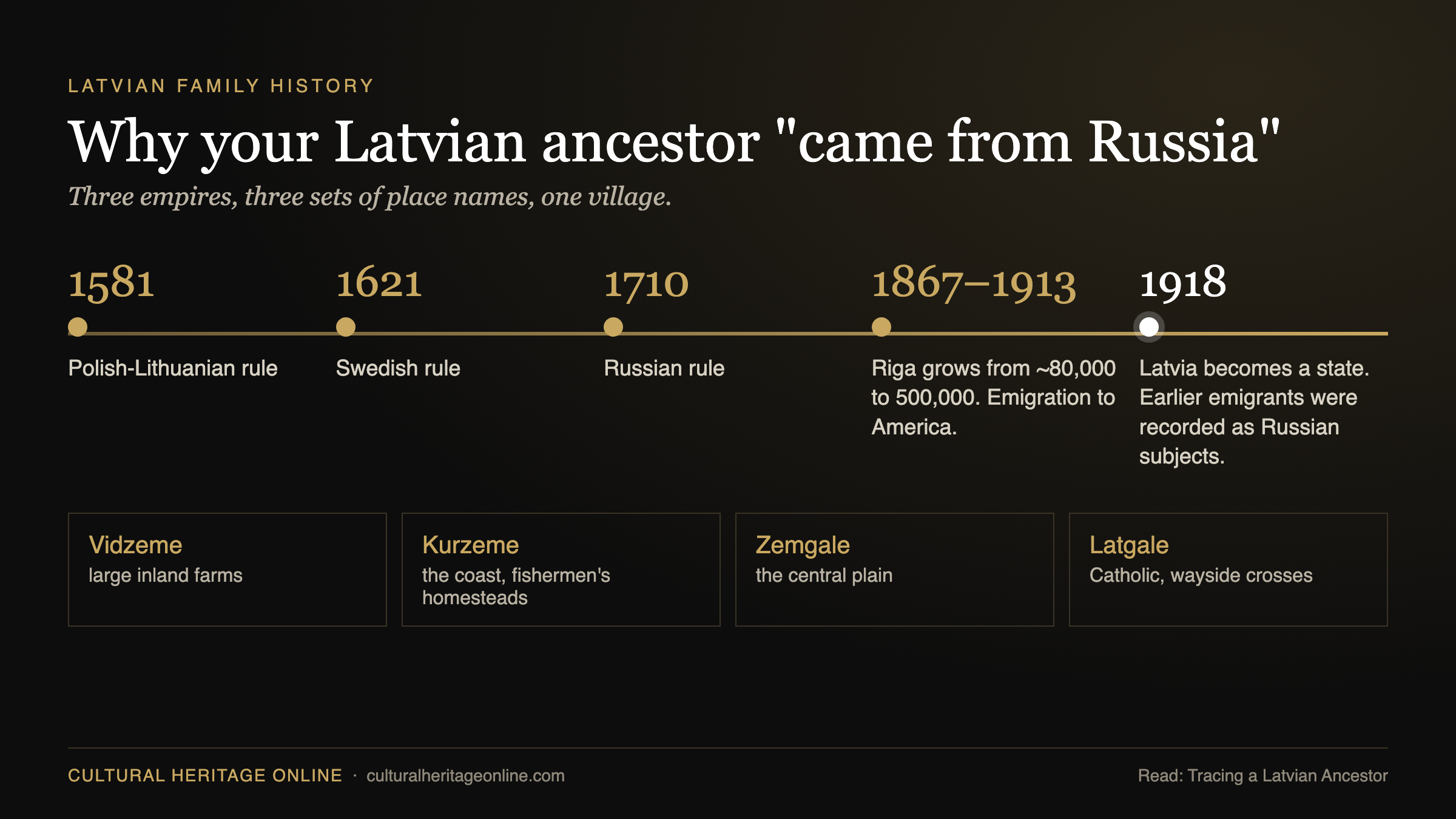
The emigration itself was huge. Between 1867 and 1913 Riga grew from roughly 80,000 people to half a million, and became the largest port of the Russian Empire. People arrived in the city from the countryside, and people left it for America.
Two things help.
The first is to treat the manifest as a pointer to the next record, not as an answer: age, occupation, last residence and the relative left behind are clues to where to look in Latvia. The second is to know which of the country's four historical regions the family came from: Vidzeme, Kurzeme, Zemgale or Latgale. Their churches, farms and record-keeping differ enough that the Ethnographic Open-Air Museum of Latvia, founded in 1924, was built around exactly that division: over a hundred rural buildings moved, region by region, to 87 hectares by Lake Jugla. Latgale is Catholic and its villages carry wayside crosses; the coast has fishermen's homesteads; inland Vidzeme has large farms.
We published the full research workflow, from the North American records to the Latvian archives, written by a specialist in the field:
Tracing a Latvian Ancestor: From the Passenger List to the Archives of Riga
https://culturalheritageonline.com/magazine/trace-latvian-ancestors-passenger-lists-archives/
And the museum where you can walk into the kind of farmhouse an emigrant family left behind:
The Ethnographic Open-Air Museum of Latvia
https://culturalheritageonline.com/places/the-ethnographic-open-air-museum-of-latvia/
Cultural Heritage Online documents heritage places with their history, sources and exact location.
_________________________
CREDITO FOTO DI COPERTINA
Cover: the Dēliņi farmhouse (1884), Ethnographic Open-Air Museum of Latvia. Photo: Adaniel, CC BY-SA 4.0, via Wikimedia Commons.





 Cultura











 Puoi sostenere i tuoi scrittori preferiti







Commento (0)